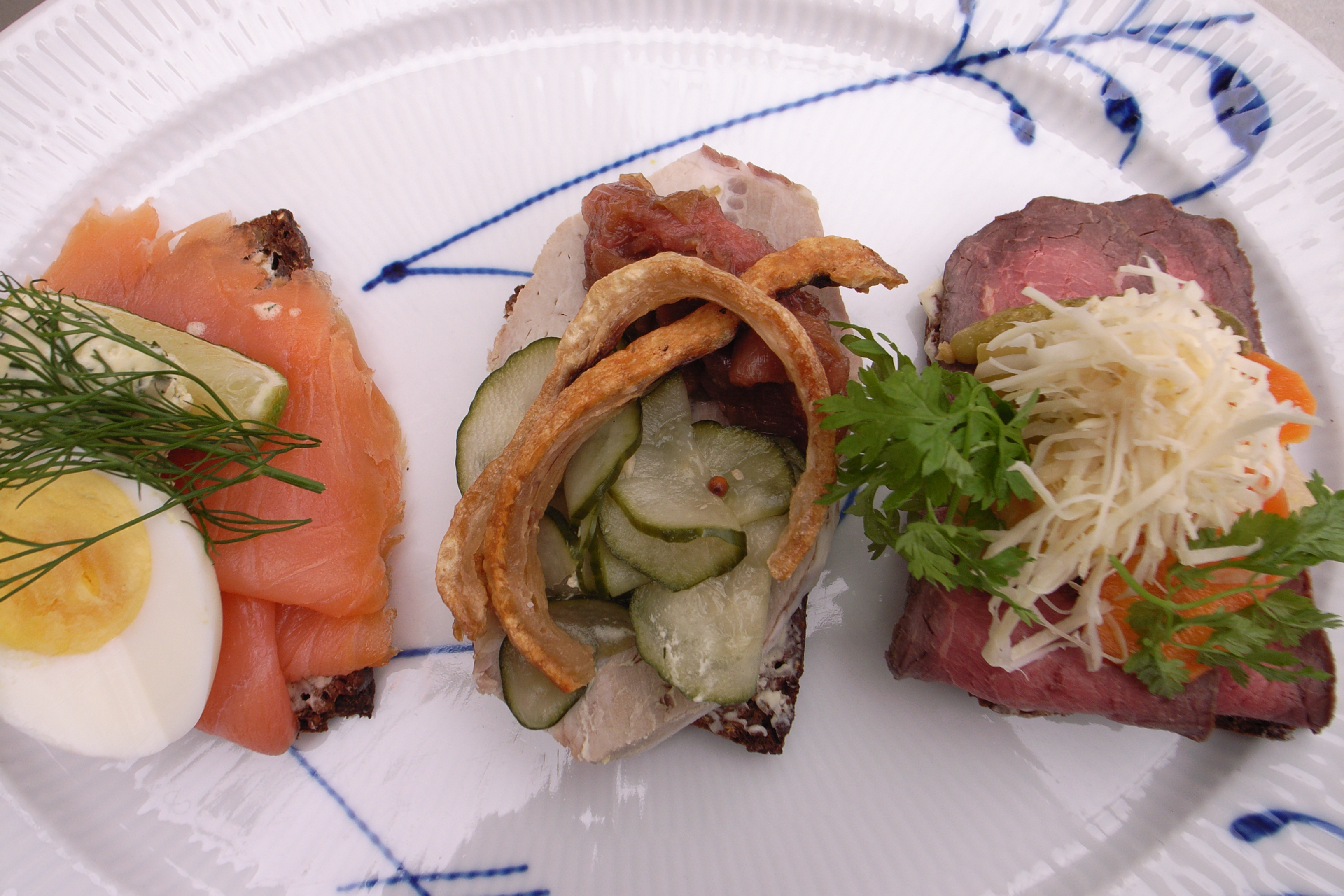
Smørrebrød — literally "buttered bread" in Danish — is one of the most recognisable elements of Danish food culture. It is not a sandwich in the conventional sense. There is no top slice. The construction is open-faced: a single slice of dense rye bread, spread with a thick layer of butter, then covered with precisely arranged toppings. The result is consumed with a knife and fork, never by hand.
The dish has been a fixture of Danish lunch tables since the 19th century, when urban workers began carrying bread with toppings to factories and workshops. Over time, the format became codified. Certain topping combinations are considered correct; others are not. The order of ingredients on the bread matters. In Copenhagen, smørrebrød is treated with the same seriousness as plated restaurant food.
The bread base
The foundation is rugbrød — a dense, moist loaf made from whole rye grain and a sourdough starter. Danish rugbrød is baked in a closed tin, which gives it a uniform rectangular cross-section. Slices are typically cut to around 8–10 mm. The bread is firm enough to support heavy toppings without becoming soggy, but its crumb retains moisture from the sourdough fermentation.
In Poland, pumpernikiel — the German-style dense rye bread widely available in supermarkets — is a close substitute. It has a similar moisture content and structural density. Alternatively, dark sourdough rye loaves found in artisan bakeries in Warsaw, Kraków and other large cities provide a near-identical base. The key quality to look for is compactness: the bread should not tear when spread firmly with butter.
The butter layer in smørrebrød is not decorative. It creates a moisture barrier between the bread and wet toppings, preventing the bread from becoming soft. Unsalted butter applied at room temperature works best; it should cover the entire surface evenly, right to the edges.
Classic toppings and their structure
Each smørrebrød topping has a defined composition. The base ingredient — fish, meat, egg or cheese — comes first, followed by garnishes that add acid, texture and colour. Below are four of the most established combinations:
| Name | Base ingredient | Garnishes |
|---|---|---|
| Dyrlægens natmad | Liver pâté, cold cuts | Pickled beetroot, aspic jelly, raw onion rings |
| Røget laks | Cold-smoked salmon | Cream cheese or scrambled egg, capers, dill, lemon |
| Rejesalat | North Sea shrimps | Mayonnaise, lemon, dill, cucumber slices |
| Roastbeef | Thinly sliced cold roast beef | Remoulade, fried onions, pickled cucumber, horseradish |
The dyrlægens natmad (veterinarian's midnight snack) is historically one of the oldest and most recognised combinations. It dates to a time when liver pâté and cold cuts were inexpensive and readily available to working households. The pickled beetroot and raw onion provide sharpness against the fat of the pâté.
Sourcing ingredients in Poland
Cold-smoked salmon (røget laks) is available in most Polish supermarkets year-round. Look for Atlantic salmon with a firm texture and no excess moisture in the packaging. Danish or Norwegian brands appear in Lidl, Biedronka and Kaufland with some regularity.
North Sea shrimps — small, cold-water shrimps with a pronounced sweet flavour — are the correct choice for rejesalat. In Poland, frozen cold-water shrimps labelled "krewetki północnoatlantyckie" or "krewetki arktyczne" are equivalent. They are available in larger supermarkets and fish shops.
Remoulade — a Danish variant made from mayonnaise, pickled vegetables and turmeric — can be prepared at home using mayonnaise, finely chopped pickled cucumber, capers and a pinch of turmeric for colour.
Sequence and presentation
At a traditional Danish lunch, smørrebrød is served in a fixed sequence. Fish preparations come first — typically herring, then other fish. Meat follows: cold cuts, then roast or fried preparations. Cheese, if served, comes last. This sequence is followed in smørrebrødsrestauranter (smørrebrød restaurants) and has its roots in the logic of flavour progression from lighter to heavier.
Home preparation does not need to follow the full formal sequence, but the structural principle holds: start with the butter, build the topping outward from the centre, and finish with the garnish arranged so that each ingredient is visible. The visual presentation is part of the dish.
Seasonal variations
Danish smørrebrød changes with the season. In spring and early summer, preparations featuring new potatoes with butter and chives, or asparagus with hollandaise, appear on menus. Autumn brings heavier combinations: roasted root vegetables, duck liver pâté, pickled red cabbage. The seasonal logic reflects the original function of the dish — using what was available from the kitchen garden or the cold store.
In Poland, this seasonal approach translates naturally. Spring radishes, cucumber and fresh dill are all available from late April onward. Late-season pickled vegetables — cucumbers, beetroot, sauerkraut — provide year-round access to the acidic elements that balance heavier toppings.
For further reading on Danish food culture and the history of smørrebrød, the Danish Food Culture resource maintained by the Danish Agricultural and Food Council provides detailed background on traditional preparations.
Last updated: May 2026